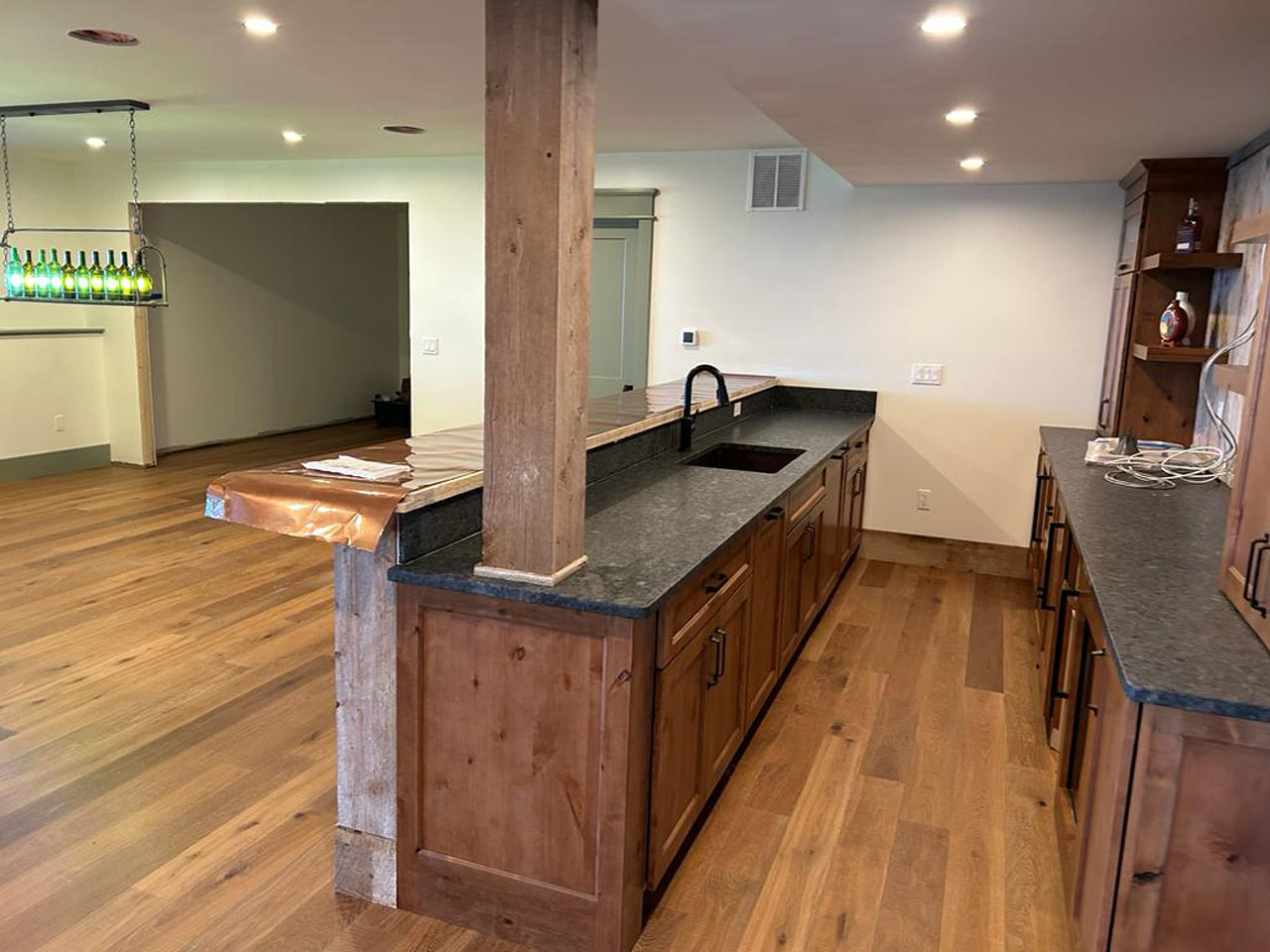
Minimalist Bathroom Countertops: Transform Your Space with Modern Vanity Tops and Sleek Designs
Minimalist bathroom countertops prioritize simple, purposeful design to transform cramped or dated bathrooms into calm, efficient spaces that feel larger and easier to maintain. This guide explores how minimalist bathroom countertop concepts combine material selection, edge and profile choices, and expert fabrication to deliver both visual clarity and lasting performance. Readers will learn what defines a truly minimalist vanity top, which materials (quartz, marble, granite, porcelain) best support minimalist goals, and how design elements like floating vanities and integrated sinks amplify perceived space. Practical sections walk through custom fabrication and installation steps, material-specific maintenance, and the 2025 trends shaping minimalist bathroom countertops. Throughout, the focus is on converting design choices into actionable specifications so homeowners and designers can move from inspiration to installation with confidence and clear expectations.
What Defines Minimalist Bathroom Countertops and Their Impact on Space?
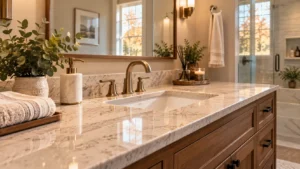
Minimalist bathroom countertops are characterized by uncluttered surfaces, restrained detailing, and geometry that emphasizes continuous planes; this design language reduces visual noise and increases perceived space by directing attention to clean lines and balanced proportions. This design approach creates visual expansion: continuous horizontal planes and narrow profiles create unbroken sightlines that make a room read as larger and more orderly. The specific benefits include easier daily cleaning, fewer visible seams and joints, and a calmer ambiance that supports a spa-like experience. Understanding these surface-driven effects helps translate abstract minimalism into measurable countertop choices and fabrication tolerances that preserve the intended aesthetic.
Minimalist countertops rely on three practical design imperatives that inform material and fabrication decisions. The next subsections explain how clean lines, functional elegance, and sensory qualities work together to shape a minimalist bathroom.
How Do Clean Lines and Uncluttered Surfaces Enhance Bathroom Design?
Clean lines and flat, continuous surfaces reduce visual clutter by minimizing edges, seams, and ornamentation, which in turn streamlines the eye and enhances perceived order in a small room. Continuous countertop planes—especially those with integrated sinks or eased straight edges—create uninterrupted reflections and light behavior that expand visual depth. In practice, designers pair low-contrast joints and narrow reveal gaps with cabinetry of matching tones to sustain the minimal effect. These approaches make maintenance simpler and reduce focal points, allowing select details like a single slab with subtle veining to act as a deliberate accent rather than visual noise.
This focus on continuity naturally leads into how functional solutions—like storage and hidden hardware—support the minimalist aesthetic without sacrificing usability.
Why Is Functional Elegance Key to Minimalist Vanity Tops?
Functional elegance means designing utility into form so storage, plumbing, and fixtures recede into the background while preserving a pared-back look. Integrated storage behind flush cabinet faces, concealed hardware, and undermount or integrated basins keep surfaces free for daily use and cleaning, reinforcing the minimalist intent. The practical benefit is twofold: countertops remain visually simple while offering the same or greater functionality than more ornate alternatives. Designers should prioritize organizational strategies that allow countertops to stay clear, because the next visual layer—surface material and finish—depends on uncluttered top planes to read as intentionally minimal.
Understanding functional elegance sets the stage for creating a spa-like atmosphere, which depends on material and finish choices to complete the sensory experience.
How Do Minimalist Countertops Create a Spa-Like Ambiance?
Minimalist countertops contribute to a spa-like ambiance by combining neutral palettes, soft finishes, and measured texture to promote calm and clarity. Light-reflective but not glossy surfaces—such as honed quartz or soft-matte porcelain—scatter light gently and reduce glare, creating a tranquil atmosphere that complements warm lighting strategies. Subtle material patterns or restrained veining become focal anchors without overwhelming the space when paired with simple hardware and muted cabinetry. The result is a bathroom that feels curated and restful, a design effect that depends on precise material selection and finishes that last through everyday use.
This sensory approach connects directly to material choice, so the next section compares the most suitable materials for modern minimalist bathroom countertops.
Which Materials Best Suit Modern Minimalist Bathroom Countertops?
Minimalist bathroom countertops demand materials that balance consistent appearance, durability, and low maintenance while supporting thin profiles and seamless integrations; quartz, marble, granite, and porcelain are the primary candidates because each offers a distinct blend of visual and functional properties. Quartz provides engineered consistency and stain resistance ideal for low-contrast minimalist palettes, while marble offers refined veining that can serve as a restrained focal point if used sparingly and sealed properly. Granite gives natural durability and subtle patterning for quieter looks, and porcelain enables ultra-thin slabs and large-format continuity for floating vanities and integrated surfaces. Choosing the right material comes down to matching porosity, finish options, typical thickness availability, and projected maintenance to the project’s minimalist priorities.
Below is a compact comparison table to translate those material attributes into clear decision points.
This table summarizes durability, porosity, maintenance, minimal-compatibility, typical thickness, and cost profile for common countertop materials used in minimalist bathroom designs.
| Material | Durability | Porosity & Sealing | Minimalist Visual Fit | Typical Thickness Options | Cost Range (indicative) |
|---|---|---|---|---|---|
| Quartz | High scratch & stain resistance | Non-porous; no sealing | Excellent for solid, uniform looks | 12–20 mm (thin profiles available) | Moderate |
| Marble | Medium; susceptible to etch/stain | Porous; periodic sealing recommended | Strong as restrained focal surface | 20–30 mm (bookmatched slabs possible) | Higher |
| Granite | High durability; natural variation | Moderately porous; occasional sealing | Good when patterns are quiet | 20–30 mm | Moderate to higher |
| Porcelain | High scratch/stain resistance | Non-porous; no sealing | Excellent for thin, large-format minimalism | 6–12 mm (ultra-thin slabs) | Moderate |
This comparison clarifies how each material supports minimalism so designers can pick the best trade-offs between look and maintenance. After assessing these attributes, the following subsections explain material-specific minimalist playbooks.
Why Is Quartz Ideal for Sleek, Durable Minimalist Vanity Tops?
Quartz is engineered from natural quartz and resin to deliver uniform color, predictable veining, and a non-porous surface suited to minimalist designs that favor consistency and low upkeep. It’s straightforward: resin binding eliminates open pores, which resists stains and reduces the need for sealing, enabling thin or eased-edge profiles without visual compromise. As an example, solid-white or soft-grey quartz slabs create continuous planes that pair well with floating vanities and integrated basins. Designers favor quartz when they want minimal visual texture and durable performance in a high-humidity bathroom environment.
This preference leads naturally to considering marble where a single slab becomes the focal feature rather than a uniform backdrop.
How Does Marble Add Timeless Elegance with Subtle Veining?
Marble contributes a quiet luxury to minimalist bathrooms by introducing restrained veining that reads as a single, sculptural surface when used sparingly. Its impact comes from visual contrast: subtle veins guide the eye without overwhelming the room if paired with neutral cabinetry and narrow edge profiles. The primary trade-off is porosity; marble requires regular sealing and careful cleaning to avoid etches from acids, so its best minimalist use is as a controlled accent or on vanity tops where maintenance is manageable. When designers choose marble for minimalism, they usually pick honed finishes and quieter vein patterns to maintain calm.
That choice contrasts with granite’s strengths for understated, durable countertops.
What Makes Granite a Natural Choice for Understated Minimalist Designs?
Granite offers durability and natural stone character that can be harnessed for minimalist spaces by selecting quieter, more uniform slabs and pairing them with thin profiles and simple edges. The stone’s granular texture scatters light softly and resists surface wear, making it a practical choice where longevity matters; occasional sealing preserves its appearance. To maintain minimalism, choose granite with subtle movement rather than high-contrast speckling and limit cabinetry ornamentation to keep the countertop plane dominant and uncluttered. Fabrication options permit eased or straight edges that reinforce the minimalist geometry.
Porcelain provides another modern path to minimalism through thin, continuous surfacing.
How Does Porcelain Offer Modern Versatility for Minimalist Bathrooms?
Porcelain slab tops are manufactured for color consistency, low weight, and thin profiles that enable near-seamless surfaces and pared-down edge treatments ideal for minimalist aesthetics. Porcelain’s manufacturing controls color and pattern tightly, and ultra-thin formats (with reinforced backing) support floating installations without heavy visual mass. Installation requires attention to substrate and support details due to thinness, but the outcome is a large-format, low-maintenance plane that reads as continuous and modern. For minimalist bathrooms seeking ultra-clean lines and integrated sinks, porcelain is an increasingly popular choice.
After selecting a material, design features and fabrication choices determine how those materials perform in minimalist installations. Below are key design strategies that enhance minimalist countertops.
How Do Key Design Elements Enhance Minimalist Bathroom Countertops?

Key design elements—floating vanities, integrated sinks, thin profiles, and simple edge details—work together to reduce visual weight and emphasize continuous planes, which is the core objective of minimalist bathroom countertops. Each element contributes to both aesthetics and function: floating installations reveal floor area, integrated sinks eliminate seams that interrupt surfaces, thin profiles reduce perceived mass, and simple eased or straight edges maintain sharp geometry. Understanding how these components interact helps designers and fabricators set tolerances and specify reinforcement or substrate work to achieve the intended minimalist effect without compromising function.
The following table maps design features to their functional and aesthetic benefits so teams can specify clear outcomes during design and templating.
| Design Feature | Characteristic | Benefit for Minimalism |
|---|---|---|
| Floating Vanity | Wall-mounted support, concealed fixings | Expands perceived floor space and reduces visual mass |
| Integrated Sink | Seamless basin formed from same slab | Simplifies cleaning and sustains continuous surfaces |
| Thin Profile | Narrow thickness (6–20 mm depending on material) | Creates a lightweight, contemporary silhouette |
| Simple Edge (eased/straight) | Minimal bevel or no-profile edge | Preserves clean lines and reduces shadowing |
This mapping helps translate design intent into fabrication requirements and supports accurate templating. The next subsections examine each element in practical detail.
What Are Floating Bathroom Countertops and Their Space-Maximizing Benefits?
Floating bathroom countertops mount to the wall structure and reveal floor area beneath, producing a visual illusion of more space and a cleaner base plane. Structurally, this requires reinforced blocking and appropriate anchoring to distribute loads—particularly important for stone slabs—and often uses lightweight or thin material options to reduce stress on the vanity. Aesthetically, the absence of a toe-kick or visible cabinetry base maintains an uninterrupted horizon line, which expands perception and simplifies cleaning. Designers typically specify 12–16 inches of clearance from floor to underside for balanced proportions and practical maintenance access.
Floating installations segue logically into integrated basins, which further reduce surface interruptions.
Why Are Integrated Sinks the Ultimate Minimalist Countertop Feature?
Integrated sinks, formed from the same slab as the countertop or fabricated to appear seamless, eliminate perimeter seams and hardware reveals that break the surface plane. Integrated sinks demand precise templating and tight tolerances for slope and drainage while maintaining minimal edge transitions. The result is a hygienic, easy-to-clean surface where water and soap residue have fewer crevices to collect, supporting the minimalist goal of uncluttered maintenance. Integrated basins pair especially well with thin profiles and simple edges, reinforcing the continuous-surface aesthetic.
With integrated sinks defined, profile thickness and edge selection complete the minimalist silhouette.
How Do Thin Profiles and Simple Edge Designs Contribute to Minimalism?
Thin countertop profiles reduce visual weight and read as delicate planes rather than heavy masses, which is vital in small bathrooms or contemporary designs where subtlety is the priority. Edge choices like eased or straight edges create clean junctions with cabinetry and lighting, and they cast less shadow than ornate profiles, preserving the minimalist geometry. For fabrication, thin profiles may require reinforcement or substrate backing to meet structural needs, especially with materials like porcelain or thin quartz, so early coordination between you and your fabricator is essential. Selecting the appropriate thinness balances aesthetics with long-term performance and installation tolerances.
These design strategies translate directly into practical small-space tactics explored next.
How Can Minimalist Bathroom Countertops Maximize Style in Small Spaces?
In small bathrooms, minimalist countertop strategies—light palettes, reflective or soft-matte finishes, and integrated solutions—work together to increase perceived space while delivering functional resilience. Light colors and high-reflectance neutrals—pure whites, soft warm grays, and pale beiges—are the most effective palettes for expanding small bathroom visuals because they increase luminance and minimize contrast between planes. This optical effect means low-contrast transitions reduce visual segmentation so walls, counters, and fixtures appear as a cohesive whole. Designers often combine a light countertop with slightly warmer cabinetry to add depth without fracturing the composition. Strategic accenting with a single darker trim or hardware piece maintains interest while preserving the dominant light field.
Choosing finishes that balance reflection and fingerprint resistance is the next critical consideration.
How Do Matte Finishes and Textured Surfaces Enhance Minimalist Appeal?
Matte and honed finishes scatter light softly and reduce glare, which can create a calming, tactile surface that is forgiving of water spots and fingerprints—attributes that sustain minimalist visuals between cleanings. Textured surfaces add subtle depth without busy patterns, enabling natural stone character or porcelain surfaces to feel refined rather than decorative. However, very textured finishes can trap grime, so designers should select low-profile textures compatible with the homeowner’s maintenance habits. The finish decision connects directly to material selection and ongoing care strategies described later.
Material selection for small bathrooms must reconcile thin profiles, easy cleaning, and restrained aesthetics.
Which Material Choices Best Support Small Bathroom Countertop Designs?
For compact bathrooms, quartz and porcelain are typically the most practical choices because they enable thin profiles, consistent color, and easy maintenance; marble can be used as a focal, and granite is better when durability is paramount. Quartz offers stain resistance and uniform tones, ideal for continuous planes that make a small room read larger, while porcelain’s ultra-thin slabs support floating installations without excess bulk. Marble’s elegant veining should be limited to a single surface to avoid overwhelming scale. Matching material and finish with the installation approach ensures that minimalism remains functional and visually coherent.
After design choices, precise fabrication and installation make the minimalist intent real; the next section details the step-by-step workflow.
What Is the Custom Fabrication and Installation Process for Minimalist Countertops?
The custom fabrication and installation process for minimalist countertops follows a precise sequence: initial consultation and material selection, accurate templating, careful fabrication with tight tolerances for integrated sinks and thin profiles, finishing, and final installation with QA checks to ensure seams, alignments, and reveals meet minimalist standards. Each stage directly impacts design outcomes—material selection sets thickness and finish options, templating specifies seam placement and sink integration, and fabrication ensures edge and surface tolerances that preserve continuous planes. Clear communication between designer, homeowner, and fabricator during templating prevents rework and ensures the installed countertop reads as intended.
Below is a numbered list that outlines the core steps teams follow to move from design to installed minimalist countertop.
- Initial consultation and material selection to align aesthetic, budget, and maintenance goals.
- Precise templating (on-site measurement) that captures thresholds for seams, integrated basins, and support points.
- Fabrication with CNC-cut templates, polishing or honing, and preparation for transport (including substrate reinforcement if needed).
- Dry-fit and adjustments to confirm seam alignment, edge continuity, and drain/slope accuracy.
- Final installation, sealing (if required), and a quality-assurance walk-through to verify minimal reveal widths and finish integrity.
This stepwise workflow clarifies responsibilities and checkpoints that protect the minimalist vision. For homeowners seeking a trusted local partner who can execute these steps, the following paragraph describes service capabilities.
How Does Classic Stoneworks Ensure Quality in Custom Minimalist Vanity Tops?
Classic Stoneworks is a leading stone fabrication and installation company serving the New England area, specializing in minimalist bathroom countertops using premium materials like Quartz, Granite, Marble, and Porcelain. We combine customer-focused service with an unwavering commitment to quality. We support clients with an indoor slab gallery for hands-on selection, clear fabrication quality checkpoints during templating and CNC cutting, and quick turnaround options designed for regional projects. Our approach emphasizes collaboration during material selection, precise templating to accommodate integrated sinks and thin profiles, and final installation QA to preserve minimal seams and alignment.
What Are the Steps for Precise Minimalist Bathroom Countertop Installation?
Precise installation begins with verified templates: an on-site template captures cabinet job conditions, plumbing locations, and any wall irregularities so seams and edge returns are planned to be visually discreet. Installers perform a dry-fit to confirm tolerances, adjust shim points and substrate backing, then make final adhesive and mechanical attachments that support thin or cantilevered profiles. Special attention is paid to seam placement—prefer seams in low-visibility areas and maintain minimal reveal widths—and to final sealant bead sizes where necessary, which keeps the plane continuous. The final quality check validates levelness, edge continuity, and basin drainage before client acceptance.
Understanding regional conditions and material availability informs these steps, which we cover next.
How Does Local New England Expertise Influence Minimalist Bathroom Projects?
Local New England expertise affects lead times, slab availability, and installation details because regional suppliers, climate considerations, and prevailing architectural details influence material choice and scheduling. Fabricators familiar with New England building practices anticipate substrate variations in older homes and coordinate blocking for floating vanities accordingly, minimizing on-site surprises. Local slab galleries reduce selection lead times and help homeowners visualize stone tone under ambient interior lighting. This local knowledge shortens decision cycles and helps preserve the minimalist intent during installation.
With installation complete, preserving the minimalist look requires material-specific maintenance guidance described in the next section.
How Do You Maintain and Care for Minimalist Stone Bathroom Countertops?
Daily care and periodic maintenance preserve a minimalist countertop’s seamless look by preventing stains, surface etches, and visible wear; recommended protocols vary by material but share a simple principle: gentle cleaners, prompt spill management, and scheduled checks for seal integrity when relevant. Quartz and porcelain require minimal maintenance—routine wiping with a pH-neutral cleaner—whereas marble and some granites benefit from regular sealing and avoidance of acidic cleaners. Consistent care protects the subtle finishes and uninterrupted planes that are central to the minimalist aesthetic.
The following table provides a concise maintenance protocol for each material to help homeowners adopt predictable routines.
| Material | Daily Cleaner | Sealing Frequency | Stain Resistance & Notes |
|---|---|---|---|
| Quartz | Mild dish soap or pH-neutral cleaner | None required | High stain resistance; avoid abrasive pads |
| Marble | pH-neutral stone soap | Every 6–12 months | Prone to etch; wipe acidic spills immediately |
| Granite | Mild cleaner | Annually or as needed | Durable but benefits from occasional sealing |
| Porcelain | Mild detergent | None required | Highly stain resistant; avoid heavy impacts |
This table clarifies how maintenance commitments differ across materials and what homeowners should expect. The next lists provide quick do’s and don’ts for daily care.
Daily cleaning protocols:
- Use a soft cloth and pH-neutral cleaner to wipe the surface after use.
- Blot spills immediately, especially oil-based or acidic substances.
- Rinse thoroughly and dry to avoid water spots or residue.
Avoid these common mistakes:
- Using acidic or abrasive cleaners that can etch marble or dull finishes.
- Allowing pooled water to sit on seams or unfinished edges.
- Dragging heavy objects that can chip thin-profile materials like porcelain.
These routines ensure minimalist countertops retain their intended appearance and function over time.
What Are the Latest Minimalist Bathroom Countertop Trends for 2025?
In 2025 minimalist bathroom countertop trends emphasize restrained statements—bold veining used sparingly, matte and honed finishes, sustainable material sourcing, and a higher adoption of floating vanities and integrated sinks that enable cleaner silhouettes. This trend balances a single, attention-grabbing surface element (for example, a soft-veined marble slab) against otherwise neutral planes to deliver an elevated yet calm composition. Sustainability considerations push eco-conscious quartz and responsibly sourced stone into project specifications, while manufacturing advances allow for larger porcelain slabs and thinner quartz options that expand design possibilities.
The following subsections outline how these trends are applied thoughtfully in minimalist projects.
How Are Bold Veining and Statement Surfaces Integrated into Minimalist Designs?
Bold veining becomes effective within minimalism when used as the singular focal element against a backdrop of neutral cabinetry and simple hardware, creating a restrained focal point without clutter. The design practice is to limit bold patterning to one surface—often the vanity top or a single wall—and keep surrounding elements quiet to prevent visual competition. Bookmatching or a single continuous slab can enhance the impact while maintaining intentional restraint. This approach relies on precise fabrication to align veins and seams so the visual effect reads as purposeful rather than accidental.
Statement surfaces tie back into sustainability and material choice, topics addressed next.
Why Are Sustainable and Eco-Friendly Materials Gaining Popularity?
Sustainable materials and low-carbon manufacturing processes are rising because clients increasingly prioritize environmental impact alongside aesthetics and durability; manufacturers now offer quartz mixes with recycled content and brands emphasizing responsible sourcing. The functional benefit is twofold: homeowners achieve a modern minimalist appearance while aligning projects with climate-aware values. Designers should ask fabricators about material provenance and recycled content claims and choose finishes that extend lifecycle performance, reducing the need for early replacement. This trend reshapes procurement decisions and promotes longer-term minimalism by focusing on durability and sourcing.
Sustainability pairs naturally with construction approaches that emphasize floating details and integrated basins.
How Do Floating Vanities and Integrated Sinks Define Modern Minimalism?
Floating vanities and integrated sinks have moved from niche to mainstream as fabrication and mounting methods have improved, enabling lighter visual composition and easier cleaning without sacrificing storage capacity. The combination of a thin-profile slab, concealed supports, and a seamless basin creates a single compositional plane that defines modern minimalist bathrooms. For 2025, the recommendation is to pair these features with matte or honed finishes and quiet material palettes to achieve contemporary minimalism that is also practically maintainable. Successful implementations depend on early coordination among designer, fabricator, and installer to ensure structural and waterproofing details are resolved before final assembly.
This article has walked through the defining principles, materials, design elements, fabrication steps, maintenance, and trends that make minimalist bathroom countertops transformative. The next step for readers is selecting materials and engaging a fabricator who can translate these specifications into a finished installation.
Frequently Asked Questions
What are the benefits of using quartz for minimalist bathroom countertops?
Quartz is an excellent choice for minimalist bathroom countertops due to its engineered consistency, high stain resistance, and non-porous surface. This material allows for thin profiles and seamless integrations, essential for achieving that clean, uncluttered look you desire. Additionally, quartz is available in a variety of colors and patterns, making it easy to find a style that complements your minimalist design. Its durability and low maintenance requirements make it ideal for high-humidity environments, ensuring that your countertop remains beautiful and functional over time.
How can I incorporate bold veining into a minimalist bathroom design?
Incorporating bold veining into a minimalist bathroom design can be achieved by using it as a singular focal point against a backdrop of neutral elements. For instance, a vanity top with striking veining can stand out when paired with simple cabinetry and understated hardware. The key is to limit bold patterns to one surface, ensuring your design remains calm and sophisticated without visual clutter. Techniques like bookmatching or using a single continuous slab can enhance the impact while maintaining a cohesive and intentional aesthetic, ensuring that the design remains calm and sophisticated.
What maintenance is required for marble countertops in a minimalist bathroom?
Marble countertops require specific maintenance to preserve their beauty and functionality, especially in a minimalist bathroom setting. Regular sealing every 6 to 12 months is essential to protect against stains and etching from acidic substances, keeping your marble looking its best. Daily care involves using a pH-neutral stone soap for cleaning and promptly wiping up spills to prevent damage. While marble can add elegance to a minimalist design, it is crucial to be mindful of its porosity and to avoid harsh cleaners that can dull its finish, ensuring the surface remains pristine and visually appealing.
How do integrated sinks enhance the functionality of minimalist countertops?
Integrated sinks enhance the functionality of minimalist countertops by creating a seamless surface that eliminates the need for perimeter seams and hardware reveals. This design choice simplifies cleaning, as there are fewer crevices for dirt and soap residue to accumulate, making daily upkeep a breeze. Additionally, integrated sinks can be crafted from the same material as the countertop, reinforcing the continuous aesthetic that is central to minimalist design. This not only improves the visual appeal but also maximizes the usability of the countertop, making it a practical choice for modern bathrooms.
What are the latest trends in minimalist bathroom countertop design for 2025?
The latest trends in minimalist bathroom countertop design for 2025 focus on bold yet restrained elements, such as the use of statement surfaces with subtle veining, matte finishes, and sustainable materials. Floating vanities and integrated sinks are becoming increasingly popular, allowing for cleaner silhouettes and easier maintenance. Additionally, there is a growing emphasis on eco-friendly materials that align with modern sustainability values. These trends aim to create serene, organized spaces that prioritize both aesthetics and functionality, perfect for your contemporary bathroom design.
How can I maximize space in a small bathroom using minimalist design principles?
To maximize space in a small bathroom using minimalist design principles, focus on light color palettes, reflective surfaces, and integrated solutions. Light colors, such as whites and soft grays, can enhance the perception of space by increasing brightness and minimizing visual breaks. Incorporating floating vanities and thin-profile countertops can also create an illusion of more floor area. Additionally, using materials like quartz or porcelain that allow for seamless installations can help maintain a clean, uncluttered look, making the bathroom feel larger and more open.
Conclusion
Embracing minimalist bathroom countertops can significantly enhance the aesthetic and functional qualities of your space, creating a serene and organized environment. By selecting the right materials and design elements, homeowners can achieve a seamless look that maximizes perceived space while ensuring durability and ease of maintenance. To explore a wide range of premium materials and expert fabrication services tailored to your minimalist vision, contact Classic Stoneworks today. Transform your bathroom into a tranquil retreat today.