Exploring Unique Bathroom Countertop Design Options: Trends, Materials, and Practical Guides for 2025
Bathroom countertop design in 2025 blends durable performance with expressive style, empowering homeowners to create truly unique vanity tops that balance aesthetics and function. This guide will help you discover what makes a bathroom countertop truly “unique,” explore the materials and finishes driving design choices, and provide practical steps to plan, fabricate, and install custom countertops that last. Homeowners often wrestle with trade-offs—beauty versus maintenance, or dramatic color versus resistance to stains—and we’ll show you how to evaluate those trade-offs to pick the perfect surface for your needs. You will learn the top materials (quartz, granite, marble, quartzite, porcelain), the 2025 trends shaping design decisions (integrated sinks, waterfall edges, bold colors, matching backsplashes), and clear guidance for durability, sustainability, and the installation timeline. Practical sections cover fabrication steps, maintenance regimens, sustainable options, and visualization tools to finalize design choices, preparing you to confidently request accurate quotes and plan your installation. Read on to compare materials, see how trends translate into fabrication choices, and understand what to expect during templating and installation.
What Are the Top Bathroom Countertop Materials for Unique Designs in 2025?
Top bathroom countertop materials in 2025 include engineered quartz, natural granite, classic marble, durable quartzite, and low-porosity porcelain; each offering distinct advantages for crafting unique vanities. Understanding the material’s porosity, maintenance needs, and aesthetic tendencies clarifies which surface will support dramatic veining, deep color, or seamless integrated sinks. Designers increasingly choose materials that pair expressive patterns with manageable care, while fabricators match edge profiles and finish types to the material’s strengths. In the following sections, we’ll unpack why each material excels for unique bathrooms and help you summarize when to choose one over another.
Why Choose Quartz for Durable and Stylish Bathroom Countertops?
Engineered quartz combines ground natural quartz with resins and pigments, producing a non-porous surface that resists stains and requires minimal sealing. Quartz’s engineered composition makes it especially suited to busy vanity tops because regular household cleaners are usually sufficient, and the material resists bacterial growth due to low porosity. Design-wise, quartz offers consistent color and pattern options—including bold and matte looks—that make it useful for matching cabinet finishes or creating a monolithic appearance. Many manufacturers provide large slab options and complementary edge profiles, allowing integrated sink silhouettes and waterfall applications that maintain quartz’s low-maintenance benefits.
How Does Granite Offer Timeless Elegance and Heat Resistance?

Granite is a natural igneous stone prized for unique mineral veining and inherent heat resistance, making it a classic choice for homeowners wanting a one-of-a-kind countertop. The stone’s crystalline structure provides strong scratch and heat performance, and with proper sealing granite handles daily bathroom use well while preserving its natural variations. A periodic sealing routine reduces absorption risk, and choosing honed or polished finishes will affect reflectivity and perceived depth of veining. Granite’s individuality helps create statement pieces—selecting a dramatic slab can become the room’s focal point while edge profiles control the overall formality of the installation.
What Makes Marble a Luxurious Choice for Bathroom Vanity Tops?
Marble is selected for bathrooms where a luxurious, marbleized aesthetic and soft veining are top priorities, but it requires careful use because of higher porosity and susceptibility to etching from acidic cleaners. That sensitivity means marble performs best on vanity tops and lower-impact areas where owners accept a gentle maintenance routine—regular sealing and cautious cleaning—to preserve surface beauty. When paired with a honed or leathered finish, marble’s tactile quality softens the look and can mask minor wear, while polished marble maximizes contrast in the veining for a high-luxury appearance. Understanding marble’s care needs before choosing it helps ensure the stone ages into character rather than unwanted staining.
When Should You Consider Quartzite and Porcelain for Bathroom Surfaces?
Quartzite and porcelain occupy strategic spots between natural beauty and maintenance practicality: quartzite offers natural stone strength with marble-like veining, while porcelain provides near-zero porosity and wide format slab options. Quartzite is ideal when homeowners want the aesthetic of marble but need greater scratch and heat resistance; it performs well in vanity areas that may see occasional heat or rough use. Porcelain slabs are engineered for extremely low water absorption, making them excellent for wet environments and for replicating bold natural patterns without the sealing demands of true stone. Choosing between them depends on how much natural variation you want versus how little maintenance you’ll accept.
How Do Material Finishes Like Matte and Honed Impact Bathroom Countertop Design?
Finishes—polished, honed, matte, and leathered—control both the visual temperature and tactile experience of a countertop, influencing light reflection, apparent color saturation, and fingerprint visibility. Polished finishes maximize color depth and shine, making veining pop and feeling slick to the touch, while honed and matte finishes reduce reflectivity for a softer, contemporary look that conceals minor wear. Leathered and textured finishes introduce three-dimensional surface detail that can make darker colors feel warmer and mask water marks, though textured surfaces may require slightly more careful cleaning. Selecting a finish is a design decision that balances desired aesthetic impact with practical maintenance behavior.
Different materials and finishes create unique design outcomes; the next section explores the specific trends that are defining those outcomes in 2025.
Before moving to trends, here is a comparison table to summarize core material attributes relevant to selection.
| Material | Porosity & Maintenance | Heat Resistance | Typical Cost Range |
|---|---|---|---|
| Quartz | Non-porous; minimal sealing; easy cleaning | Moderate; resin limits extreme heat exposure | Mid-range |
| Granite | Low-moderate porosity; periodic sealing | High; excellent heat resistance | Mid to high |
| Marble | Higher porosity; regular sealing; careful cleaners | Moderate; sensitive to acidic agents | High |
| Quartzite | Low-moderate porosity; sealing recommended | High; durable under heat | Mid to high |
| Porcelain | Near-zero porosity; virtually maintenance-free | High; excellent thermal stability | Mid to high |
This table clarifies how porosity and maintenance needs align with aesthetic choices and practical performance, guiding the next decisions about finishes and fabrication.
What Are the Latest Bathroom Countertop Design Trends for 2025?
Design trends for 2025 emphasize seamless integration, sculptural forms, and expressive color while balancing longevity and maintenance for everyday use. Integrated sinks, waterfall edges, bold dark palettes, and matching countertops with backsplashes lead the list because they deliver strong visual cohesion and modern silhouettes. These trends pair with material choices—engineered quartz for seamless integrated sinks, large-format porcelain for continuous waterfall panels, and granite or quartzite for bold veining—so material selection is tightly coupled to the trend you want to achieve. In the next subsections, we’ll explain how each trend is fabricated and help you decide when to choose one over another.
The most influential trends for 2025 and their design benefits include:
- Integrated sinks for a seamless, hygienic surface that minimizes seams and simplifies cleaning.
- Waterfall edges that continue material vertically for a sculptural, high-end effect.
- Bold and dark countertop colors for dramatic contrast and contemporary luxury.
- Matching countertops and backsplashes to create a cohesive, uninterrupted visual field.
These trends inform material choices and fabrication techniques; the following sections drill into how integrated elements and edge details are executed.
How Do Integrated Sink Countertops Create Seamless and Modern Bathroom Designs?
Integrated sink countertops are fabricated by shaping the countertop slab or joining seamless sections so the sink basin appears formed from the same material as the top, eliminating visible seams and reducing crevices where dirt accumulates. This approach improves hygiene and creates a continuous surface that reads as custom sculpture rather than applied fixtures, and it typically requires precise templating and skilled edge profiling from the fabricator. Materials like quartz and porcelain are often preferred for integrated sinks because they can be manufactured or machined for watertight joints; natural stones can be worked into integrated shapes but may require more complex finishing. Planning for plumbing placement and overflow details during templating ensures the final integrated sink functions as well as it looks.
Why Are Waterfall Edge Countertops Gaining Popularity in Bathroom Renovations?

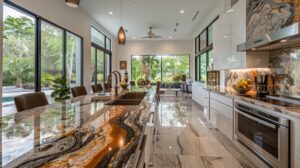
Waterfall edges extend the countertop material vertically down the vanity face, producing a monolithic, architectural appearance that emphasizes material continuity and modern minimalism. The waterfall look requires additional slab material and careful joinery at internal corners or cabinet terminations to maintain structural integrity and visual flow. Large-format porcelain and thick quartz or stone slabs are popular choices because they support clean vertical drops and can be finished consistently across the face and top. Designers often use waterfall panels to visually anchor vanities or to highlight feature walls, and the approach pairs well with integrated sinks for a fully joined, sculptural result.
What Are the Benefits of Bold and Dark Color Choices for Bathroom Countertops?
Deep hues and bold colors give bathrooms drama, create striking contrast with lighter cabinetry or fixtures, and can visually ground open-plan spaces; dark countertops also reduce perceived brightness, which designers use to create cozy, sophisticated retreats. Materials like engineered quartz and certain granites provide consistent deep color options, while textured finishes can mitigate fingerprint visibility on dark surfaces. When choosing a dark countertop, consider lighting strategy and hardware finish to ensure the space maintains balance and contrast, and plan cleaning regimens because darker finishes can reveal dust or water spots more readily under certain lighting. Used judiciously, bold colors elevate vanity design into a focal design element.
How Can Matching Countertops and Backsplashes Enhance Bathroom Cohesion?
Matching countertops and backsplashes create a continuous visual plane that makes small bathrooms feel more cohesive and larger by removing visual interruptions and repeating patterns. This technique is especially effective with slab materials that show continuous veining or with large-format porcelain that mimics natural stone across surfaces. Matching also simplifies selection because the same slab can be used for both top and backsplash, but it increases material needs and can raise cost due to larger slab consumption and more complex templating. Where continuity is desired, designers choose matching materials intentionally to emphasize flow; where contrast adds interest, an alternative backsplash material can highlight the countertop instead.
To illustrate how trends translate into fabrication choices, the next section highlights how a local fabricator ensures quality and supports homeowners through selection and installation.
How Does Classic Stoneworks Ensure Quality Custom Fabrication and Installation in New England?
Classic Stoneworks is your trusted partner for custom stone fabrication and professional installation of bathroom countertops throughout New England, emphasizing unparalleled quality craftsmanship and customer satisfaction. Our strength lies in our seamless templates-to-install workflows and our expansive indoor slab gallery, where clients can view full slabs and finishes under consistent lighting conditions to make truly informed selections. We fabricate with only premium materials—including granite, marble, engineered quartz brands, and porcelain—ensuring homeowners can perfectly match trends with durable substrates while relying on our experienced templating and installation teams. Ready to move from design to project planning? We offer inspiring portfolio previews and a powerful visualizer tool to refine your choices before requesting a quote or showroom visit.
What Is the Custom Stone Fabrication Process for Bathroom Countertops?
The custom fabrication process begins with precise templating, where on-site measurements and plumbing locations are recorded to create accurate digital or physical templates that guide cutting and edge work. Fabrication includes slab selection, CNC or waterjet cutting, edge profiling, sink cutouts, finishing, and quality inspections to verify tolerances and finish consistency before delivery; these steps ensure seams are minimized and edge profiles align with design intent. Quick turnaround depends on slab availability and scheduling between templating and installation, and professional fabricators coordinate with contractors to minimize disruption during removal and installation.
A numbered list below outlines the typical fabrication stages homeowners should expect.
- Templating and measurement to capture accurate field dimensions and fixture locations.
- Slab selection and cutting, including edge profile machining and sink cutouts.
- Finishing, polishing, and quality checks performed in the workshop before delivery.
- Delivery, site placement, seam joining, and final polishing or sealing on site.
These steps reduce installation surprises and help homeowners anticipate the schedule and site preparation needed for a smooth install.
How Does Classic Stoneworks’ Indoor Slab Gallery Help in Material Selection?
Our indoor slab gallery allows clients to view full slabs under consistent lighting and to compare scale, veining, and finish options side by side, which is critical because small samples rarely convey the full visual impact of a slab. By seeing whole slabs, you can make confident choices about vein match, color saturation, and whether a slab’s natural pattern aligns with your design goals, while our expert advisors can recommend complementary edge profiles and finishes. Practical visiting tips include bringing cabinet samples or paint swatches to assess color relationships and asking to visualize how an integrated or waterfall application will use the slab. Matching expectations with slab reality reduces selection regrets and streamlines the quoting process.
What Are the Advantages of Quick Turnaround and Professional Installation?
Our quick templating-to-install timelines reduce project disruption, allowing you to sequence other trades more predictably and limit bathroom downtime during renovations. Our professional installers deliver accurate fit, stable joinery, and thorough post-install inspections to confirm seam alignment, edge finish, and sealing—services that protect long-term performance and appearance. Coordinated installation also typically includes site protection, removal of old countertops, and final clean-up so the renovation finishes on schedule and with minimal homeowner inconvenience. Fast and professional service supports design intent from selection through final inspection and often enhances overall project satisfaction.
After understanding fabrication and selection, homeowners need guidance selecting durable, low-maintenance options; the following section compares materials for longevity and care.
How Do You Choose the Most Durable and Low-Maintenance Bathroom Countertop?
Choosing the most durable and low-maintenance bathroom countertop requires balancing resistance to stains and heat with the aesthetic you want; engineered quartz and porcelain commonly top the list for low maintenance, while sealed granite and quartzite offer strong durability with a moderate care routine. Evaluate porosity, sealing requirements, and abrasion resistance when making choices, and prioritize non-porous options in high-traffic or moisture-prone bathrooms. Cost, desired edge complexity, and whether you want integrated sinks or waterfall panels also affect the durability equation because fabrication complexity can influence slab joins and seam resilience. The next subsections offer targeted answers about resistance, maintenance routines, porosity effects, and cost ranges.
Which Materials Offer the Best Stain and Heat Resistance for Bathrooms?
Non-porous engineered quartz and porcelain provide the best overall stain resistance because their surfaces resist liquid absorption and bacterial harboring, making routine cleaning straightforward. For heat resistance, natural stones like granite and quartzite outperform resin-based surfaces, tolerating warm styling tools and brief heat exposure without damage, though prolonged direct heat contact is discouraged on any countertop. When designing for frequent heat exposure, select granite or quartzite or specify protective practices such as trivets; for high stain-resistance needs, quartz or porcelain reduce sealing and maintenance burdens while delivering a wide palette of finishes.
What Maintenance Is Required for Natural Stone vs. Engineered Quartz?
Natural stones such as granite and marble typically need periodic sealing—frequency depends on porosity and finish—to maintain stain resistance, and owners should avoid acidic cleaners on sensitive stones like marble. Engineered quartz requires simpler maintenance: routine wiping with mild detergent and avoiding abrasive pads preserves finish and prevents resin damage.
A practical maintenance checklist reduces long-term wear:
- Wipe daily with mild, pH-neutral cleaner.
- Avoid acidic or abrasive cleaners on natural stone.
- Use coasters and trivets to prevent direct heat contact.
- Re-seal natural stone as recommended (often annually to every few years).
Adopting these routines extends countertop life while preserving the original appearance.
To summarize maintenance differences in a compact format, the table below compares stain resistance, sealing frequency, expected lifespan, and best-use scenarios.
| Material | Stain Resistance | Sealing Frequency | Best-Use Scenario |
|---|---|---|---|
| Quartz | High (non-porous) | None | High-traffic vanities, low maintenance |
| Granite | Moderate-high | Every 1–3 years | Heat exposure, natural look |
| Marble | Moderate | Every 6–12 months | Low-impact vanity tops, luxury aesthetic |
| Quartzite | High | Every 1–3 years | Durable natural look, heat-prone areas |
| Porcelain | Very high | None | Wet areas, shower walls, continuous slabs |
This comparison helps homeowners choose materials aligned with their maintenance tolerance and usage patterns.
How Does Porosity Affect Bathroom Countertop Performance?
Porosity measures how much liquid a material absorbs; high-porosity materials risk staining and bacterial ingress if unsealed, while non-porous surfaces prevent penetration and are easier to sanitize. Natural stones vary widely: marble tends to be more porous than granite, so sealing frequency and care differ accordingly, whereas engineered quartz and porcelain have near-zero porosity. Mitigation strategies include choosing non-porous materials for high-use surfaces, applying proper sealants to porous stones, and selecting finishes that mask wear; these choices directly affect long-term appearance and hygiene.
What Are the Cost Ranges for Custom Bathroom Countertops by Material?
Cost ranges reflect material price, slab yield, fabrication complexity, and additional features like integrated sinks or waterfall panels; understanding common bands helps set realistic budgets. Typical cost drivers include edge profile complexity, seamed versus monolithic installations, sink integration, and decorative treatments—each can add to labor and slab consumption. For accurate project estimates, request a custom quote that accounts for slab selection and the specific fabrication requirements; this ensures budget alignment with design ambitions.
The following numbered list outlines common cost drivers homeowners should expect.
- Material selection and slab grade, which affects per-square-foot cost.
- Fabrication complexity, including integrated sinks and custom edge profiles.
- Installation logistics, seam count, and required slab yield for waterfall panels.
Understanding these drivers guides budgeting decisions and helps prioritize which design elements are essential.
What Sustainable and Eco-Friendly Bathroom Countertop Options Are Available in 2025?
Sustainable countertop choices in 2025 include recycled quartz, composite surfaces with post-consumer content, and locally sourced natural stone that reduces transport emissions and supports regional supply chains. Recycled quartz and composites lower demand for virgin materials and can achieve strong performance and attractive aesthetics, while locally sourced stones reduce embodied carbon by shortening distribution distances. Choosing sustainable materials involves trade-offs—availability, color variety, and cost—so decision-making should weigh environmental impact alongside durability and design goals. The subsections below explain recycled quartz, local New England stone options, and composite benefits.
How Is Recycled Quartz Contributing to Eco-Friendly Bathroom Designs?
Recycled quartz blends reclaimed stone fragments and industrial byproducts with binders to create slabs that reduce the need for virgin raw materials and landfill disposal. These surfaces maintain many performance advantages of engineered quartz—low porosity and consistent appearance—while offering eco-conscious consumers an alternative that reduces embodied resource use. Design possibilities include a range of colors and aggregate appearances, and performance metrics generally match or approach standard engineered quartz for stain resistance and maintenance. For homeowners prioritizing sustainability, recycled quartz provides a balance of environmental benefit and everyday practicality.
What Natural Stone Options Are Locally Sourced in New England?
Sourcing natural stone locally in New England reduces transportation emissions and supports regional quarries and fabricators, making it an attractive sustainability strategy for homeowners who want authentic stone with lower embodied carbon. Common regional materials include locally quarried granites and other stones that mill locally, although availability varies by project and season; fabricators can advise on current slab inventories and sourcing verification. Choosing local stone also simplifies logistics for replacement slabs and can strengthen relationships with local craftsmen, aligning design priorities with environmental stewardship.
Why Choose Composite and Recycled Materials for Bathroom Countertops?
Composite and recycled materials offer predictable performance, low porosity, and customizable appearances while lowering environmental impact through reclaimed content or reduced extraction of virgin stone. These materials often have consistent color and pattern options and can be engineered with surface characteristics that mimic natural stone or create unique aggregate looks. Maintenance is typically straightforward, and cost-effectiveness varies by brand and composition, so homeowners should weigh sustainability credentials, warranty terms, and long-term performance when comparing composites to natural stone.
To help compare sustainable options at a glance, the following table summarizes embodied carbon/recyclability and local availability for common eco-friendly choices.
| Material | Embodied Carbon / Recyclability | Local Availability in New England |
|---|---|---|
| Recycled quartz | Lower embodied carbon; uses reclaimed aggregates | Available via specialty slabs and fabricators |
| Composite (recycled content) | Varies; often recyclable components | Regional suppliers provide select products |
| Locally sourced stone | Lower transport emissions; natural recyclability | Depends on quarried materials and inventory |
| Porcelain (recycled content) | Low absorption; some manufacturers use recycled inputs | Large-format suppliers deliver regionally |
This comparison helps homeowners prioritize environmental benefits alongside design and durability needs.
What Should You Expect During the Bathroom Countertop Installation Process?
The bathroom countertop installation process follows a predictable sequence—templating, fabrication, delivery, installation, and sealing—with clear homeowner preparation steps and timelines that minimize surprises. Knowing what each phase involves reduces stress and ensures the final result aligns with design intent and functionality. The subsections below detail templating practices, delivery and installation day expectations, and sealing and finishing recommendations so you can plan accordingly.
How Is the Templating and Measurement Conducted for Custom Countertops?
Templating captures precise field dimensions, plumbing locations, and any irregular surfaces so the fabricator can create accurate cutting files or physical templates; modern templating often uses digital scanners or detailed manual templates depending on the fabricator. Homeowners should clear countertops and ensure access to plumbing fixtures for accurate measurement, and designers should confirm sink placement and faucet types prior to templating. Accurate templates reduce fitting issues during installation and decrease the likelihood of onsite modifications that can delay timelines. Preparing the site and verifying fixture details before templating help streamline the subsequent fabrication stage.
What Happens During Delivery and Professional Installation?
On installation day, professionals protect flooring and nearby surfaces, remove old countertops if needed, place new slabs or sections, join seams with precision, set sinks, and secure countertops to cabinetry while verifying level and fit. Installers perform final sealant application where required, check for plumbing clearances, and complete a final inspection to ensure edge profiles and joint appearance meet quality standards. Homeowners should expect a clear timeline for the day, temporary disruption while heavy equipment is moved, and a post-install walkthrough to confirm satisfaction. Professional installation minimizes callbacks and ensures warranty standards for the work are upheld.
How Are Countertops Sealed and Finished for Long-Term Protection?
Sealing methods vary by material: natural stones commonly receive a penetrating sealer applied on site after installation and periodically thereafter, while engineered materials like quartz and porcelain generally require no sealing but may receive protective finishes in specific applications. Finish choices—polished, honed, matte—can influence how sealants interact with the surface and how often maintenance is needed, so fabricators will recommend appropriate products and frequencies. Post-install guidance includes recommended cleaning agents, stain-removal protocols, and an expected maintenance schedule to preserve appearance and performance. Following fabricator recommendations ensures the longevity of both aesthetic and functional properties.
The numbered checklist below outlines homeowner preparation for templating and installation.
- Clear vanity tops and adjacent work areas for templating and installation access.
- Confirm fixture types and sink/faucet placements prior to templating.
- Coordinate schedules with installers to ensure minimal disruption and adequate site protection.
Preparation and communication with the fabricator improve accuracy and reduce installation day surprises.
How Can You Visualize and Plan Your Unique Bathroom Countertop Design?
Visualization and planning tools help translate inspiration into measurable decisions—selecting slab type, edge profile, integrated sink options, and finish while anticipating material needs and costs. Using a bathroom visualizer tool or portfolio review allows homeowners to test combinations virtually and decide whether to pursue integrated sinks, waterfall edges, or dramatic color choices. Classic Stoneworks offers a powerful bathroom visualizer and an inspiring portfolio of completed projects to assist you with these decisions. We encourage homeowners to prepare project photos and fixture specs before requesting a custom quote or showroom appointment. The next subsections explain how to use visualization tools, where to review portfolio examples, and how to request a custom consultation efficiently.
How Does the Classic Stoneworks Bathroom Visualizer Tool Help in Design Decisions?
Our bathroom visualizer tool enables you to experiment with material, color, edge profile, and sink configurations in a digital mock-up, reducing uncertainty and narrowing your slab choices before a showroom visit or template appointment. The tool’s value lies in testing multiple combinations quickly and saving visuals to share with our expert fabricators for more accurate quoting and slab recommendations. Combining virtual exploration with an indoor slab gallery visit ensures the virtual selection translates to real-world slab scale and finish. Using the visualizer first streamlines the selection process and helps focus a showroom visit on the most promising slabs.
Where Can You See Portfolio Examples of Unique Bathroom Countertop Projects?
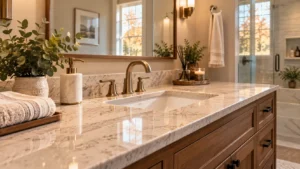
Reviewing our portfolio examples—from small vanities to luxury bathrooms, waterfall installations, and integrated-sink projects—shows how materials, edge details, and finish choices truly transform spaces and helps set realistic expectations for scale and finish. When evaluating portfolio images, note seam placement, edge treatments, and how lighting affects color perception; these observations can guide your slab choice and finish selection. Classic Stoneworks’ project gallery highlights local New England installations that illustrate current trends and the practical outcomes of different material choices. Observing similar projects helps homeowners communicate desired outcomes clearly to fabricators and designers.
How Do You Request a Custom Quote or Consultation for Your Bathroom Countertop?
To request a custom quote or consultation, we recommend preparing key project information—current photos, measurements, desired material types or references, preferred edge profile, and any integrated features like sinks or waterfall panels—to enable an accurate initial estimate. Share design snapshots from the visualizer or portfolio examples to convey style intent, and be ready to schedule a templating appointment for precise pricing and fabrication planning. Expect a typical response timeline for initial consultations from professional fabricators that includes next steps: slab selection, templating scheduling, and a projected fabrication-to-install timeframe. Clear project documentation expedites quoting and helps align scope with budget expectations.
The guidance in this article equips you to compare materials, match trends with fabrication realities, and plan installation steps with a local fabricator. Use visualization tools, slab galleries, and clear project details to get accurate quotes and achieve a unique, lasting bathroom countertop that fits your design and lifestyle.
Frequently Asked Questions
What factors should you consider when choosing a bathroom countertop material?
When selecting a bathroom countertop material, consider factors such as porosity, maintenance requirements, heat resistance, and aesthetic appeal. Non-porous materials like quartz and porcelain are easier to maintain and resist stains, while natural stones like granite and marble offer unique beauty but require more upkeep. Additionally, think about the countertop’s durability in relation to your bathroom’s usage, the desired design style, and your budget. Balancing these elements will help you choose a material that meets both functional and aesthetic needs.
How can you ensure your bathroom countertop installation goes smoothly?
To ensure a smooth bathroom countertop installation, start by preparing your space. Clear the area of any items and confirm plumbing fixture placements before templating. Communicate clearly with your fabricator about your design preferences and any specific requirements. On installation day, expect some disruption, so plan accordingly. Professional installers will protect your home, remove old countertops, and ensure precise fitting. A post-install walkthrough will help confirm that everything meets your expectations, so be ready to ask questions and provide feedback.
What are the common mistakes to avoid when selecting your bathroom countertop?
Common mistakes when selecting your bathroom countertop include overlooking maintenance needs, not considering the countertop’s porosity, and failing to match the material with the overall design theme. Additionally, many homeowners underestimate the importance of lighting and how it affects color perception. It’s also crucial to avoid rushing the decision; take the time to explore different materials and finishes, and utilize visualization tools to see how your choices will look in your space. Proper planning can prevent costly regrets later on.
How do you maintain your bathroom countertop to ensure its longevity?
Maintaining your bathroom countertop involves regular cleaning and adhering to specific care guidelines based on the material. For engineered quartz and porcelain, simply wipe with a mild detergent. Natural stones like granite and marble require periodic sealing to protect against stains and damage. Avoid using acidic or abrasive cleaners on sensitive surfaces. Additionally, using coasters and trivets can prevent heat damage. Following a consistent maintenance routine will help preserve the countertop’s appearance and functionality over time.
What are the benefits of using sustainable materials for your bathroom countertops?
Using sustainable materials for your bathroom countertops offers several benefits, including reduced environmental impact and support for local economies. Materials like recycled quartz and locally sourced stones lower carbon footprints by minimizing transportation emissions and utilizing reclaimed resources. These options often maintain high performance and aesthetic appeal while promoting eco-friendly practices. Choosing sustainable materials can also enhance your home’s value and appeal to environmentally conscious buyers, making it a smart investment for the future.
How can you visualize your bathroom countertop design before installation?
To visualize your bathroom countertop design before installation, utilize design tools such as a bathroom visualizer, which allows you to experiment with different materials, colors, and edge profiles in a digital format. Additionally, visiting a slab gallery can help you see full slabs under consistent lighting, providing a better sense of scale and finish. Collecting inspiration from portfolio examples can also guide your choices. Combining these methods will help you make informed decisions and ensure your design aligns with your vision.
Conclusion
Choosing the right bathroom countertop can transform your space, combining durability with unique design elements that reflect your personal style. By understanding the benefits of various materials and the latest trends, you can make informed decisions that enhance both functionality and aesthetics. Take the next step in your renovation journey by exploring our selection of premium materials and expert guidance. Start planning your dream bathroom countertop today!